
 S1001 Jumpsuit Chayenne
 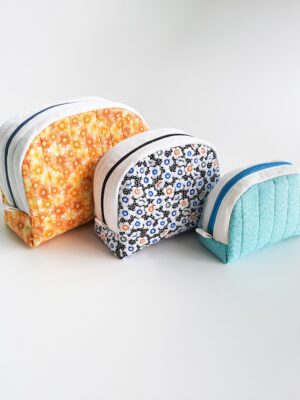 Curvy Pouch Pattern/ S/M/L 3 sizes
How to Choose Sewing & Quilting Needles
(Finding the Perfect Match for Your Fabric and Thread)
@Evelyn Wood
@SewJessalli
@Juki Junkies
Step-by-Step Instructions:
Using the wrong needle is the number one cause of skipped stitches, shredded thread, and ruined fabric. Matching your sewing machine or hand quilting needle to your fabric weight and thread type is crucial for a frustration-free project.
Things to Consider:
- Fabric weight (lightweight silk vs. heavy denim)
- Fabric weave (tight wovens vs. stretchy knits)
- Thread type (cotton, polyester, thick topstitching)
- Project type (piecing vs. quilting through layers)
Tips for Success:
- Change your sewing machine needle after every 8 to 10 hours of active sewing. Needles get dull very fast!
- If your sewing machine sounds “thumpy” or loud as it pierces the fabric, it is time for a new needle.
- Use a magnifying glass or your phone’s camera to read the tiny sizing numbers engraved on the needle shank.
1. Understand Machine Needle Sizing
- Sewing machine needles have two numbers (e.g., 80/12). The first is the European metric size, and the second is the US size. Lower numbers (60/8) are for fine, lightweight fabrics. Medium numbers (80/12 or 90/14) are for quilting cottons. High numbers (100/16 or 110/18) are for heavy denim, canvas, or bags.
2. Choose the Right Point Type
- Universal: A slightly rounded tip that works for most standard wovens and some sturdy knits.
Microtex/Sharp: A very sharp point for piercing tightly woven fabrics like batik, silk, or faux leather to create perfectly straight stitches.
Ballpoint/Stretch: A rounded tip designed to slip between the loops of knit and spandex fabrics without cutting the fibers.
3. Specific Needles for Quilting
- Quilting Needles: These have a special tapered point designed to penetrate multiple layers (top, batting, and backing) and easily cross over thick intersecting seams without skipping stitches.
4. Match the Eye to the Thread
- Your thread should pass freely through the eye of the needle. If you are using a thick topstitching thread in a size 70/10 needle, the thread will shred. Switch to a “Topstitch” needle, which has a much larger eye and deeper groove to accommodate thick threads.
5. Choosing Hand Quilting Needles
- For hand quilting, you want a needle called a “Between.” Betweens are very short and stiff, allowing you to easily rock the needle through the quilt layers to create tiny, precise running stitches. (For general hand sewing, use “Sharps,” which are longer).
Top FAQs for Choosing Needles:
Why is my sewing machine skipping stitches? +
Skipped stitches are almost always a needle issue! Your needle might be dull, bent, or inserted backward (the flat side of the shank usually goes to the back). It could also be the wrong type for your fabric (e.g., using a sharp needle on a highly stretchy knit). Try a brand-new needle first.
Why does my thread keep breaking and shredding? +
This happens when the eye of the needle is too small for the thread you are using. The friction of passing through the tiny hole repeatedly shreds the thread fibers. Move up a needle size, or switch to a Topstitch or Metallic needle, which feature elongated eyes.
What needle should I use for piecing quilting cotton? +
An 80/12 Universal or an 80/12 Microtex (Sharp) needle is perfect for piecing standard quilting cottons. If you are using very fine thread (like 50wt Aurifil), you can often size down to a 70/10 Microtex for incredibly precise, flat seams.
