
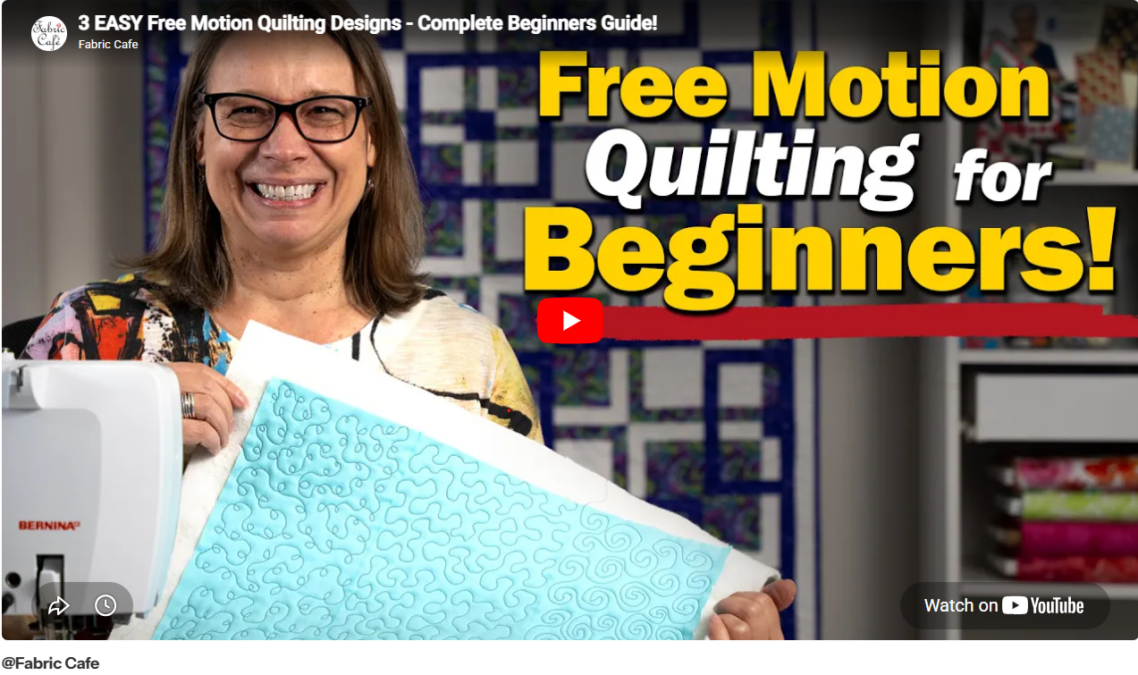
Free Motion Basics
@Fabric Cafe
@Tiny Orchard Quilts
@Living Water Quilter
Step-by-Step Instructions:
Free motion quilting (FMQ) allows you to move the fabric in any direction, effectively letting you “draw” or “doodle” with thread. It takes practice to find the rhythm between your machine’s speed and your hand movement, but the creative possibilities are endless.
Materials Needed:
- Darning foot (free motion foot)
- Basted quilt sandwich
- Quilting gloves (highly recommended)
- A Supreme Slider or Teflon mat (optional)
Tips for Success:
- Drop your shoulders and breathe! Tensing up makes your movements jerky.
- Practice on scrap quilt sandwiches before you ever touch your finished quilt top.
- Fast pedal, slow hands. Let the needle fly while you smoothly glide the fabric.
1. Prep the Machine
- Remove your standard presser foot and attach the darning foot. Drop your feed dogs. (If your machine cannot drop its feed dogs, set your stitch length to 0 or cover them with a specialized plate).
2. Bring Up the Bobbin Thread
- Place your fabric under the needle. Take one full stitch down and up, pulling the top thread slightly to bring the bobbin thread up to the top of the quilt. Hold both thread tails as you take your first few stitches to prevent a bird’s nest on the back.
3. Position Your Hands
- Put on your quilting gloves. Place your hands flat on either side of the presser foot, forming a loose “C” shape with your thumbs and index fingers to frame the needle. Your hands act as the steering wheel.
4. Find the Rhythm
- Press the foot pedal to a steady, medium-fast speed. Begin sliding the fabric gently under the needle. You are now controlling the stitch length! If you move your hands too fast, your stitches will be huge. If you move them too slowly, the stitches will build up into a knot.
5. Doodle with Thread
- Try sewing simple “C” curves, continuous loops, or meandering stippling. Keep your eyes looking slightly ahead of the needle to plan where you want the design to go next.
6. Stop with the Needle Down
- When you need to adjust your grip, release the foot pedal but make sure the needle stops down in the fabric to anchor it. Reposition your hands comfortably, and resume sewing.
Top FAQs for Free Motion Quilting:
What is a darning foot and why do I need it? +
A darning foot (or free motion foot) is a specialized presser foot that hovers just slightly above your fabric. It drops down to clamp the fabric exactly when the needle penetrates, preventing the fabric from flagging (riding up the needle), but springs back up so you can slide the fabric freely between stitches.
Why do I need to drop my feed dogs? +
The feed dogs are the metal teeth that pull your fabric in a straight line backward. Dropping them below the needle plate removes their grip on the fabric entirely, granting you 360-degree freedom to move the quilt sideways, backward, and diagonally.
Why are my stitches completely different sizes? +
In free motion quilting, your hands determine the stitch length. If you move your hands fast while pressing the pedal lightly, your stitches will be huge. If you move your hands slowly while pressing the pedal hard, they will be microscopic. Finding a steady, synchronized rhythm takes practice!
Why is my thread skipping or breaking? +
This usually happens because you are jerking the fabric or moving it too fast while the needle is still in the down position, which bends the needle and snaps the thread. It can also be caused by a dull needle or the wrong type of needle for quilting.
Do I really need to use quilting gloves? +
While not strictly mandatory, they are highly recommended. Quilting gloves have rubberized fingertips or palms that grip the fabric effortlessly. Without them, you have to push down very hard with your bare hands, which leads to intense shoulder and wrist fatigue very quickly.
Can I free motion quilt on a regular sewing machine? +
Yes! As long as you can either drop your feed dogs (or cover them) and attach a darning foot, almost any modern domestic sewing machine is capable of free motion quilting. You don’t need a specialized longarm machine to create beautiful designs.
