
 Snow White Embroidered Stripes Crinkled Chiffon
  Brown, Beige and Red Wool Boucle Embroidered Polyester Satin with Sequins and Floral Applique Stripes
 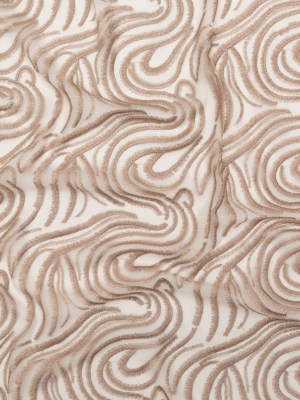 Abstract Embroidered Tulle - Metallic Pink Powder
Couching
Attaching cords or yarn for decoration
@Julija_Gobere
@ProfessorPincushion
@MissouriQuiltCo
Step-by-Step Instructions:
Couching is a decorative sewing technique where a thicker thread, yarn, or cord is laid on the surface of the fabric and stitched in place with small, nearly invisible stitches—perfect for embellishing garments, home decor, or art textiles with unique texture and flair.
Materials Needed:
- Base fabric (woven cotton, linen, felt, or canvas recommended)
- Decorative cord, yarn, ribbon, or thick thread
- Matching or invisible thread for stitching
- Hand-sewing needle or couching presser foot (if using a machine)
- Embroidery hoop (optional for hand couching)
- Fabric marking tool or chalk
- Scissors
- Pins or temporary fabric adhesive
Tips for Perfect Couching:
- Choose a strong contrasting couching thread for visible, artistic effects or matching thread for a subtle finish.
- Use stabilizer if your fabric is lightweight or stretchy.
- Always test on a scrap first to perfect your tension, spacing, and stitch length.
- Use curved or sinuous lines to enhance the dimensional look.
- If machine couching, a free-motion or couching foot gives best control over curves.
1. Prepare Your Design and Materials
- Draw your desired design or lines directly onto the fabric using a fabric marking pen or tailor’s chalk.
- Cut your couching cord/yarn to length, leaving a little extra on each end to allow for trimming.
2. Secure the Base Fabric
- If hand sewing, place your fabric in an embroidery hoop to keep it taut.
- If machine sewing, ensure your fabric is interfaced or stabilized to avoid puckering.
3. Position the Decorative Thread or Yarn
- Lay the cord along your drawn line, gently pinning it in place or using a small amount of fabric glue or basting stitches to hold it temporarily.
4. Couch by Hand
- Thread a hand needle with matching or invisible thread and make small perpendicular stitches over the cord, spaced 1/8″ to 1/4″ apart.
- Secure the couching thread underneath the fabric between each stitch to keep the surface neat.
- Continue along the entire length of the design, taking care to keep the cord flat and aligned with the marked lines.
5. Couch by Machine
- Attach a presser foot, couching foot, free-motion foot, or zigzag foot to your machine, depending on the effect you want.
- Set the machine to a wide zigzag stitch if not using a couching foot.
- Slowly stitch over the cord, ensuring the needle lands on both sides without piercing the cord.
- Pivot carefully around curves to maintain the shape of your design.
6. Secure the Ends
- At the beginning and end of the cord, either tuck the ends to the back of the fabric and stitch down or trim neatly and secure with extra stitches.
7. Finishing Touches
- Gently press the fabric on the reverse side using a pressing cloth.
- Remove any visible markings and secure loose threads.
