
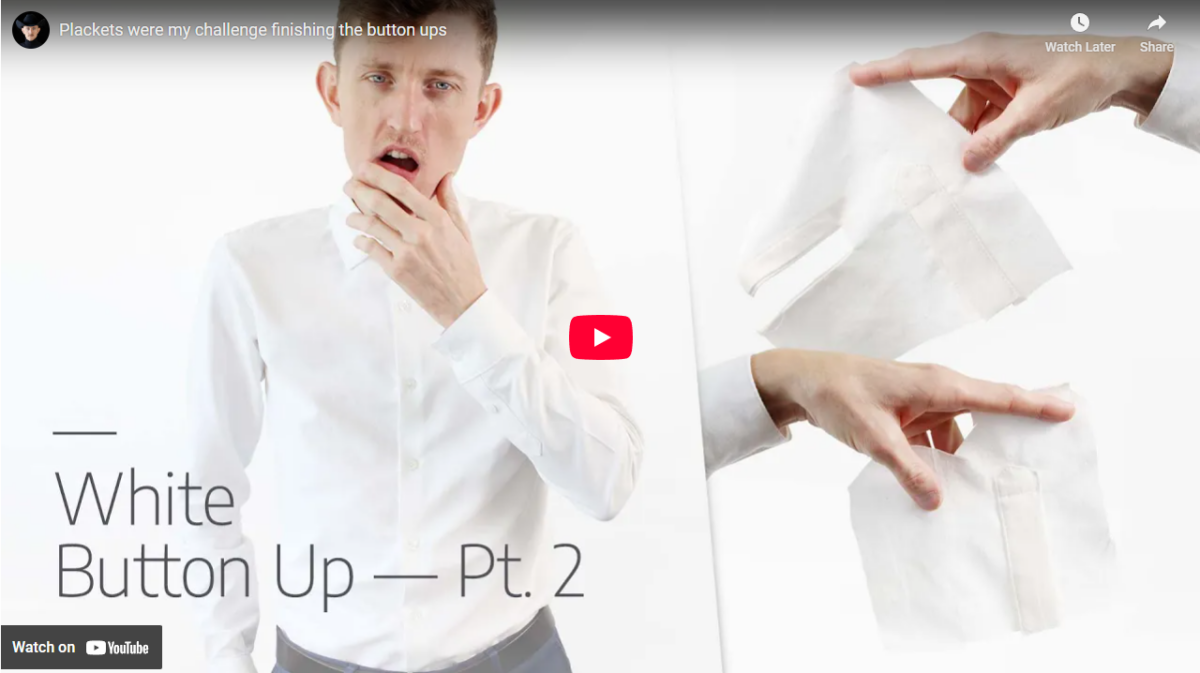
Placket Construction
@CorneliusQuiring
@Wardrobebyme
@named-clothing
Step-by-Step Instructions:
With this clear step-by-step method, you’ll be able to confidently sew tailored or bound plackets that add strength, elegance, and function to your garment designs.
Materials Needed:
- Fabric with placket marking
- Lightweight fusible interfacing (optional for stability)
- Coordinating thread
- Fabric marking tool
- Scissors or rotary cutter
- Ruler or seam gauge
- Iron and pressing surface
- Pins or fabric clips
- Sewing machine
Tips Before You Begin:
- Always mark your placket length and placement clearly on the wrong side of the fabric before cutting.
- Use lightweight interfacing to reinforce the placket area—especially for lightweight or loose-weave fabrics.
- Pressing after each step ensures crisp lines and a cleaner finish.
- Practice the technique on a scrap piece before applying it to your garment.
- Choose a placket style (continuous bound, tailored/two-piece, or faced) that best suits your fabric weight and design.
1. Mark the Placket Opening
- On the wrong side of your fabric, mark the placket center line and stitching lines.
- Use a ruler to ensure the lines are straight and even.
- Mark the placket length according to your pattern or intended opening.
2. Reinforce the Placket Area (Optional)
- Cut a strip of lightweight interfacing slightly longer and wider than your placket area.
- Fuse it to the wrong side of the fabric, centered over the placket markings.
3. Cut the Placket Opening
- Stitch along your marked stitching lines (usually forming a narrow V at the bottom).
- Carefully cut along the center line, stopping at the V, and clip to—but not through—the point of the stitching
4. Attach the Placket Pieces
- For a two-piece/tailored placket (e.g., shirt sleeve):
- Cut two placket strips—one wider (underlap) and one narrower (overlap).
- Fold under seam allowances along one long edge of each piece and press.
- With right sides together, align the raw edge of the narrower piece with one side of the placket slit; sew and press outward.
- Fold the placket to the wrong side, encasing the seam, and topstitch in place.
- Repeat with the wider piece on the opposite side, overlapping the narrower placket when finished.
- Topstitch the placket into a clean rectangular or pointed finish, securing both ends.
- For a continuous bound placket (e.g., lightweight blouses):
- Cut one long bias strip about 1.5″–2″ wide.
- With right sides together, pin the strip to the placket opening, aligning raw edges.
- Stitch using a ¼” seam allowance, easing the strip around the slit.
- Press the seam toward the strip, then fold the strip over to the wrong side to cover the seam.
- Tuck the raw edge under and topstitch the binding in place neatly.
5. Final Pressing and Finishing
- Press the entire placket flat, ensuring the edges and corners are crisp.
- Add any closures such as buttons or snaps as needed.
- Check for symmetry and even topstitching for a polished result.
