
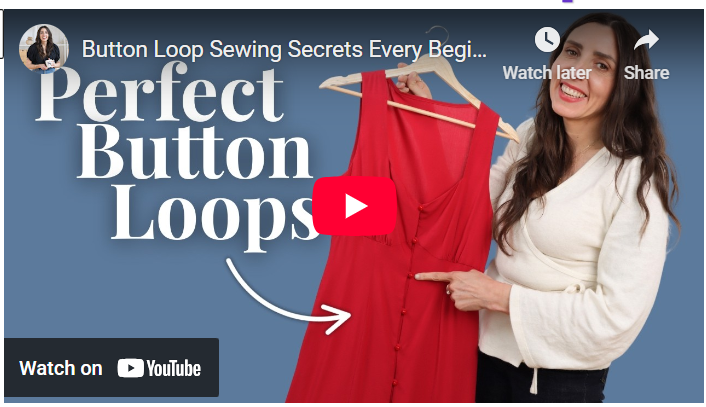
How to Make Button Loops (Rouleau Loops)
@SeamWork
@Tailornour
Step-by-Step Instructions:
Learn how to make button loops (also called rouleau loops) to create elegant, custom fabric closures for dresses, blouses, wedding gowns, and special occasion garments—perfect for beginners and advanced sewists seeking polished, couture-quality finishes.
Materials Needed:
- Fabric (lightweight to medium-weight woven cotton, silk, satin, crepe, or linen—bias-cut strips work best for flexibility)
- Sewing machine and matching thread
- Fabric scissors or rotary cutter and mat
- Quilting ruler or seam gauge
- Fabric marking tool (chalk, frixion pen, or washable marker)
- Pins or clips
- Iron and pressing surface
- Loop turner, tube turner, or rouleau turner tool (small sizes: 1/8 in to 1/4 in)
- Alternative turning tools: tapestry needle, bobby pin, or safety pin
- Optional: Bodkin or tweezers for narrow tubes
- Optional: Cord or string for corded rouleau loops
- Optional: Wonder Tape for precise positioning during attachment
Tips for Perfect Button Loops
- Cut on the bias: Bias-cut fabric strips create smoother, rounder tubes that curve beautifully and resist fraying.
- Start wider than you think: A 1 in wide strip yields a 1/4 in finished tube after seaming and turning; test your fabric first.
- Stitch with a short stitch length: Use 1.5–2 mm stitch length to prevent gaps when turning and handling narrow seams.
- Grade seam allowances: Trim one seam allowance slightly narrower than the other to reduce bulk inside the tube.
- Turn gently: Never force the turner through—work slowly and use a blunt tool to avoid tearing delicate fabrics.
- Press before cutting loops: Press the finished tube flat before measuring and cutting individual loops for consistent sizing.
- Test loop size with your button: Slide the button through a sample loop; it should fit snugly but slide through without distorting the fabric.
- Secure ends well: Backstitch or lockstitch when attaching loops to prevent pull-out under stress.
1. Cut Bias Strips
- Determine the width of your bias strip: for a 1/4 in finished tube, cut strips 1 in wide; for 1/8 in tubes, cut 3/4 in wide (adjust based on fabric weight and desired final diameter).
- Fold your fabric at a 45-degree angle to the selvage to find the true bias.
- Use a quilting ruler and rotary cutter to cut strips along the bias grain.
- If you need a longer tube, piece bias strips together: place two strips right sides together at a 90-degree angle, stitch diagonally across the intersection, trim to 1/4 in, and press open.
2. Prepare the Strip
- Fold the bias strip in half lengthwise, wrong sides together, and press lightly to establish a center crease.
- Open the strip and optionally mark a stitching line down the center with chalk or disappearing marker (this guide helps keep narrow seams consistent).
3. Stitch the Tube
- Fold the strip in half lengthwise, right sides together, aligning raw edges precisely.
- Pin or clip along the length.
- Set your machine to a short stitch length (1.5–2 mm) and use a universal or microtex needle for fine fabrics.
- Stitch a narrow seam allowance—typically 1/8 in to 1/4 in depending on your strip width—keeping the seam straight and even.
- Backstitch at the beginning; at the end, leave thread tails long (6–8 in) if using the thread-pull turning method.
- Trim one seam allowance slightly narrower than the other (grade) to reduce bulk.
4. Turn the Tube (Method A – Loop Turner Tool)
- Insert the wire or hook end of your loop turner into one end of the tube.
- Push the turner through the entire length until the hook emerges from the opposite end.
- Catch the fabric at the entry end onto the hook or latch.
- Gently pull the turner back through, easing the fabric tube right side out as you go.
- Work slowly and avoid pulling too hard, especially with delicate or lightweight fabrics.
- Once turned, use a blunt tool (like a chopstick or knitting needle) to gently push out the seam from inside if needed.
5. Turn the Tube (Method B – Safety Pin or Bobby Pin)
- Attach a small safety pin or bobby pin to one end of the tube (at the seam allowance, not the folded edge).
- Work the pin back through the inside of the tube, bunching fabric as you push.
- Continue until the pin emerges from the opposite end, turning the tube right side out.
- Remove the pin and gently pull the tube to smooth and straighten.
6. Turn the Tube (Method C – Thread Pull)
- Before stitching, insert a double strand of strong thread or thin cord through the tube and catch it in the starting seam stitches.
- After stitching the tube, trim seam allowances close (but not too close).
- Gently pull the secured thread to draw the tube through itself, turning it right side out.
- This method works well for very narrow tubes but requires care to avoid breaking the thread.
7. Press and Prepare the Tube
- Press the turned tube flat with the seam running along one edge (not centered) for a cleaner finish.
- Roll the tube gently between your fingers to settle the seam and shape the tube evenly.
- Measure the button diameter and add 1/2 in to 3/4 in extra length per loop for seam allowance and ease.
- Mark and cut individual loops from the tube using fabric scissors—cut cleanly and at right angles.
8. Attach Button Loops to Garment (Sandwiched Method)
- Mark button loop placement on the garment edge using your pattern markings or by measuring evenly.
- Fold each loop in half to form a teardrop or “U” shape.
- Pin or baste loops to the right side of the garment edge, aligning raw edges with the garment raw edge and pointing the loop inward (toward the garment body).
- Space loops evenly and ensure all loops extend the same distance from the edge.
- Place your garment facing (or lining piece) right sides together over the loops, sandwiching them between the two layers.
- Stitch along the seam line, securing the loops in the seam.
- Trim, grade, and clip seam allowances; press seam open or toward the facing.
- Turn the facing to the inside; press the finished edge with loops extending outward.
- Understitch or edgestitch the facing to keep it flat and the loops crisp.
9. Attach Button Loops (Exposed/Topstitched Method)
- Position loops on the finished garment edge, spacing evenly.
- Fold raw ends of each loop under or overlap them slightly; pin in place.
- Topstitch a small square or rectangle over the loop base to secure, backstitching for strength.
- Alternatively, hand-stitch loops invisibly using a slip stitch or whipstitch for a couture finish.
10. Troubleshooting Common Issues
- Tube won’t turn: Seam allowance may be too wide for the strip width—try a narrower seam or wider strip.
- Fabric tearing during turning: Use a gentler turning tool, shorter stitch length, and avoid forcing; delicate fabrics may need a corded rouleau.
- Loops too tight or too loose: Test loop size with the actual button before cutting all loops; adjust length as needed.
- Loops twisting: Press tubes flat before cutting and ensure raw edges align when pinning to garment.
- Seam visible on outside: Press tube with seam along the edge, not centered, and roll tube gently to hide seam inside.
11. Optional – Corded Rouleau Loops
- Cut a piece of thin cord (crochet cotton, perle cotton, or rattail cord) twice the length of your fabric tube plus several inches.
- Fold the cord in half and place the folded end inside the fabric strip before stitching.
- Stitch the tube, catching the cord in the seam at the starting end but leaving the cord free to move inside.
- After stitching, pull the cord ends to turn the tube right side out around the cord.
- Trim away excess cord at the ends.
- Corded loops are stronger, easier to turn, and hold their shape better than uncorded tubes.
