Hand Embroidery Stitches
@HandiWorks
@SarahHomfreyEmbroidery
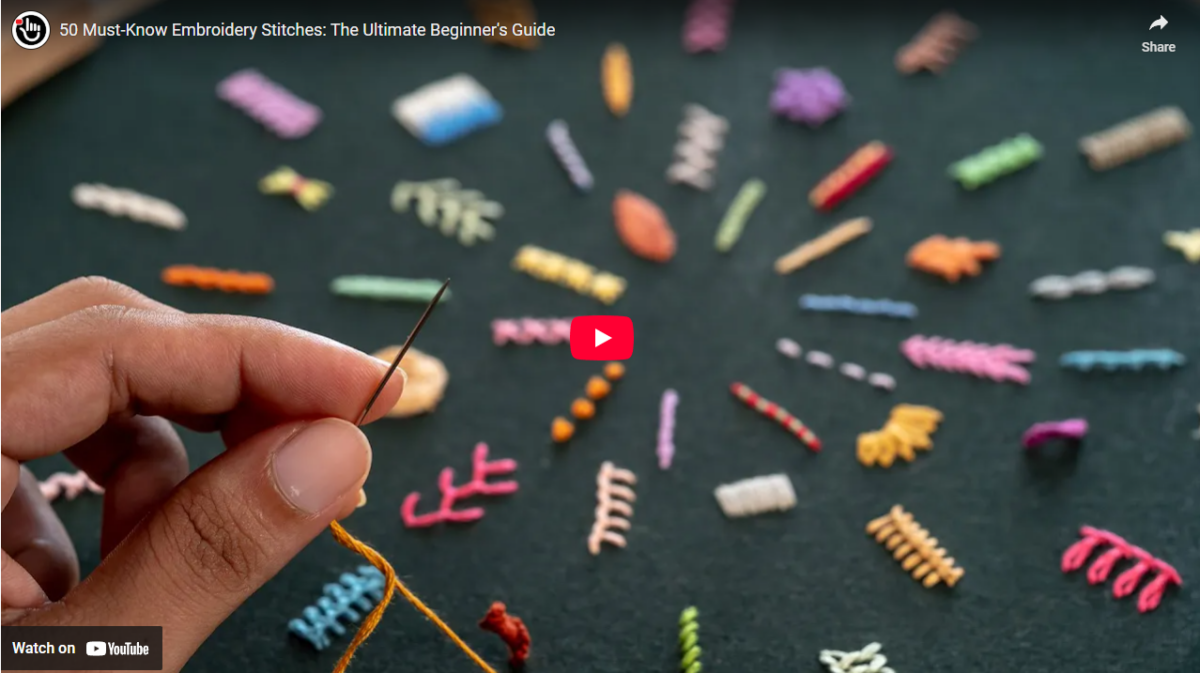
@letsexplore2125
Step-by-Step Instructions:
Learn how to sew hand embroidery stitches step-by-step to add beautiful, personalized, and intricate detail to your garments, crafts, and home décor.
Materials Needed:
- Embroidery hoop
- Embroidery floss (6-strand cotton or silk thread)
- Embroidery needles (size 7–10)
- Fabric (cotton, linen, or muslin)
- Fabric marking pen or pencil
- Scissors
- Optional: Stabilizer (for delicate or stretchy fabrics)
Tips Before You Begin:
- Always separate embroidery floss strands if you want finer lines or detail—2–3 strands work best for delicate stitching.
- Use an embroidery hoop to keep fabric taut and prevent puckering.
- Practice on scrap fabric before stitching your final project.
- Knot your thread ends securely, or use a waste knot or away knot technique for a neater finish.
- Keep your stitches consistent in length for a polished appearance.
1. Running Stitch
- Bring the needle up at point A.
- Move the needle forward and down at point B.
- Bring it back up at point C, spacing stitches evenly.
- Repeat to create a dashed line.
2. Backstitch
- Bring your needle up through the fabric at point A.
- Insert the needle down at point B (the length of one stitch ahead).
- Bring the needle up again at point C (one stitch length forward).
- Insert the needle back down at point A, completing your first stitch.
- Continue stitching by repeating the process—each new stitch moves one
- length forward and finishes one stitch length back.
3. Chain Stitch
- Bring the needle up at point A.
- Insert the needle back down at point A, and bring it back up slightly ahead at point B while keeping the thread looped under the needle.
- Pull the thread through to form a loop.
- Repeat to continue the chain.
- To finish, anchor the final loop with a small straight stitch over it.
4. Stem Stitch
- Bring the needle up at point A.
- Insert it down at point B and bring it back up halfway between A and B at point C, keeping the thread below the needle.
- Continue stitching with the same rhythm and spacing for a rope-like line.
5. Satin Stitch
- Draw or trace the shape to be filled.
- Bring the needle up at the outer edge of the shape.
- Insert the needle directly across the shape to the other edge.
- Bring it back up next to the first stitch and repeat side-by-side to fill the shape.
6. French Knot
- Bring the needle up at point A.
- Wrap the thread 2–3 times around the needle.
- Insert the needle back into the fabric near (but not the same as) point A.
- Pull the thread taut while pushing the needle down to secure the knot.
7. Lazy Daisy (Detached Chain Stitch)
- Bring the needle up at point A.
- Insert it back at point A and bring it up at point B, a short distance away, with the thread looped under the needle.
- Pull through to form the petal.
- Anchor the top of the petal with a tiny stitch across the loop at point B.
8. Blanket Stitch
- Bring the needle up at the starting point.
- Insert the needle down vertically and back up
- horizontally to the right, keeping the working thread under the needle.
- Pull the needle through to create a cornered stitch.
- Repeat across the edge to form evenly spaced loops.
9. Split Stitch
- Bring the needle up at point A.
- Insert it down slightly ahead at point B.
- Bring the needle back up through the center of the stitch between A and B.
- Continue stitching by splitting the previous stitch each time.
10. Herringbone Stitch
- Bring the needle up at point A and go diagonally down to point B.
- Come up again diagonally at point C (below point A), and cross diagonally to point D.
- Repeat in a criss-crossing pattern for a decorative border.