
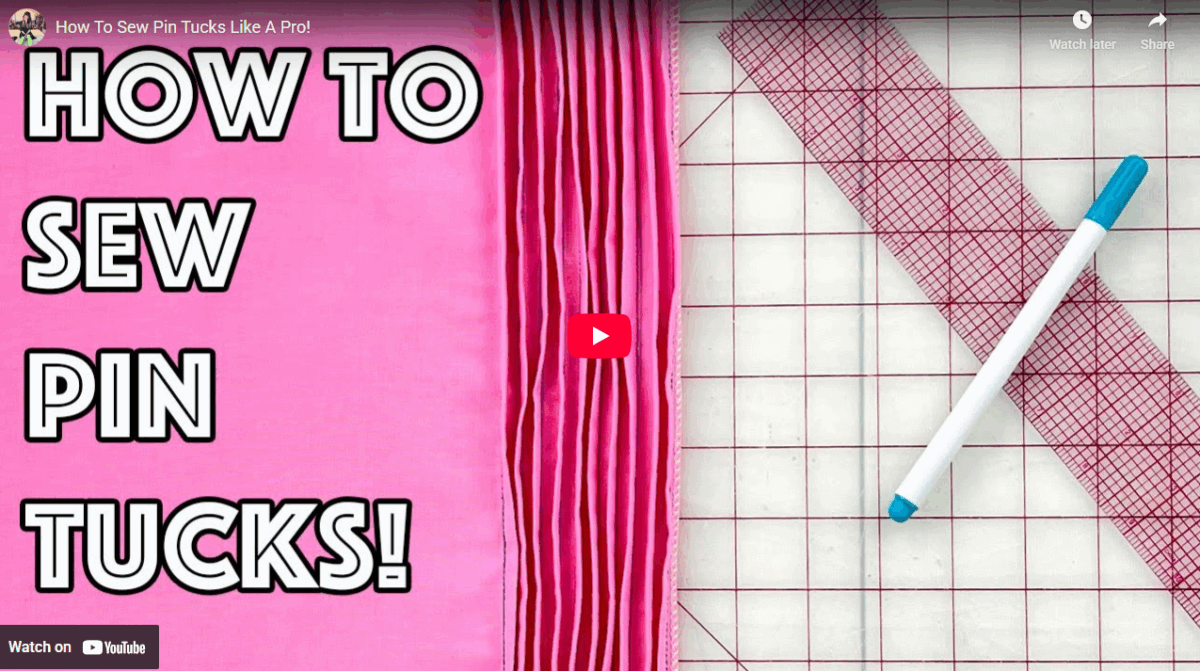
How to Sew Tucks
Pin, Pleated, and Spaced
@SingerSewingCompany
Step-by-Step Instructions:
Learn how to sew tucks—pin, pleated, and spaced—to add elegant texture and dimension to garments, heirloom projects, and home décor with professional precision perfect for beginners through advanced sewists.
Materials Needed:
- Fabric (lightweight cotton, linen, lawn, batiste, or silk for pin tucks; medium-weight cotton or linen for wider tucks)
- Sewing machine with straight stitch capability
- Pin tuck foot or edge-stitching foot (for pin tucks)
- Standard presser foot and zipper foot (for pleated and spaced tucks)
- Twin needle (optional for pin tucks)
- Matching thread or decorative thread
- Quilting ruler or seam gauge
- Fabric marking tool (chalk, water-soluble marker, or frixion pen)
- Pins or clips
- Iron and pressing surface
- Spray starch or fabric stabilizer (optional for crisp tucks)
- Optional: Tuck guide template or cardboard spacer
- Optional: Cord or pearl cotton (for corded pin tucks)
Tips for Perfect Tucks:
- Start with extra fabric: Tucks consume width—add 1/3 to 1/2 more fabric width than your finished measurement requires.
- Mark before you fold: Use a ruler and marking tool to ensure even spacing; consistent tucks depend on accurate marking.
- Press as you go: Press each tuck before stitching the next one for crisp, professional results.
- Test on scraps: Practice your tuck width and spacing on fabric scraps to perfect tension and stitch length.
- Grain line matters: Always work on straight grain for tucks that lay flat; bias tucks will distort.
- Thread tension balance: Slightly tighter upper tension helps tucks fold crisply; test and adjust.
- Use spray starch: Light starch helps maintain sharp folds, especially on lightweight fabrics.
- Batch process: Mark all tucks first, then press all, then stitch all for efficiency and consistency.
1. Prepare Your Fabric
- Pre-wash and press your fabric to prevent shrinkage after tucks are sewn.
- Cut fabric on straight grain with extra width to accommodate tuck take-up (add 1/3 to 1/2 more than finished width needed).
- Apply light spray starch for crisp folds if desired.
- Mark the first tuck placement line parallel to the fabric edge using a ruler and marking tool.
2. Pin Tucks – Narrow Decorative Tucks
- Mark fold lines 1/8 in to 1/4 in apart for traditional pin tucks.
- Fold fabric wrong sides together along the marked line and press.
- Using a pin tuck foot, align the fold under the groove and stitch close to the fold edge (about 1/16 in from fold).
- Alternative twin needle method: Mark stitching lines instead of fold lines; stitch with twin needle and tighten bobbin tension slightly to raise the tuck.
- For corded pin tucks: Place pearl cotton or cord under the fold before stitching to create raised dimension.
- Continue across fabric, maintaining consistent spacing between tucks.
3. Pleated Tucks – Wide Folded Tucks
- Mark fold lines and stitching lines based on desired tuck width (common widths: 1/4 in, 1/2 in, or 1 in).
- Calculate spacing: For touching tucks, space equals twice the tuck width; for spaced tucks, add desired gap to the calculation.
- Fold fabric wrong sides together along the fold line and press firmly.
- Measure from the fold to mark your stitching line (this determines tuck width).
- Stitch along the marked stitching line using a straight stitch and standard presser foot.
- Press all tucks in the same direction for uniform appearance.
- Optional: Edgestitch along the fold for a crisp finish on wide tucks.
4. Spaced Tucks – Decorative Separated Tucks
- Determine tuck width and spacing between tucks (common: 1/4 in tucks with 1/2 in spacing).
- Mark fold lines across entire fabric piece using the combined measurement of tuck width plus spacing.
- Mark stitching lines the width of your tuck from each fold line.
- Fold and press each tuck along fold lines.
- Stitch each tuck at the marked stitching line.
- Press all tucks in one direction or alternate directions for different effects.
- For graduated spacing: Vary the gap between tucks, starting narrow and gradually increasing.
5. Cross Tucks – Intersecting Horizontal and Vertical
- Complete all horizontal tucks first following steps above.
- Press tucks in one direction.
- Rotate fabric 90 degrees and mark vertical tuck placement.
- Fold and stitch vertical tucks, crossing over horizontal tucks.
- Press vertical tucks perpendicular to horizontal tucks for a textured grid effect.
6. Finishing Tucks
- After all tucks are complete, press entire piece from the wrong side.
- Stay-stitch across tuck ends within the seam allowance to secure before assembling garment pieces.
- For released tucks: Stop stitching at a marked point and backstitch; tucks below this point will fan out.
- Trim fabric to pattern size after tucking is complete, centering design as needed.
7. Creative Variations
- Curved tucks: Use a curved template to mark and stitch gently curved tuck lines.
- Colored thread: Use contrasting thread for decorative effect on pin tucks.
- Cluster tucks: Group 3-5 narrow tucks together with wider spaces between clusters.
- Graduated widths: Vary tuck widths from narrow to wide for visual interest.
8. Troubleshooting Common Issues
- Uneven spacing: Use a tuck guide or cardboard template to maintain consistent measurements.
- Puckering fabric: Reduce stitch length and check thread tension; ensure fabric is on straight grain.
- Tucks won’t lay flat: Press with steam and starch; check that fold and stitching lines are parallel.
- Fabric distortion: Stabilize lightweight fabrics with spray starch or temporary stabilizer before tucking.
More Sewing Techniques!



Top FAQs for this technique:
Add 1/3 to 1/2 more fabric width than your finished measurement; each 1/4 in tuck uses 1/2 in of fabric width.
Pin tucks are very narrow (1/16 in to 1/8 in) decorative tucks; pleated tucks are wider (1/4 in or more) and create more pronounced folds.
Straight tucks work best on straight edges; for curves, use released tucks that fan out or carefully ease the fabric while stitching.
Use a pin tuck foot with grooves, a twin needle, or an edge-stitching foot to maintain consistent narrow spacing from the fold.