
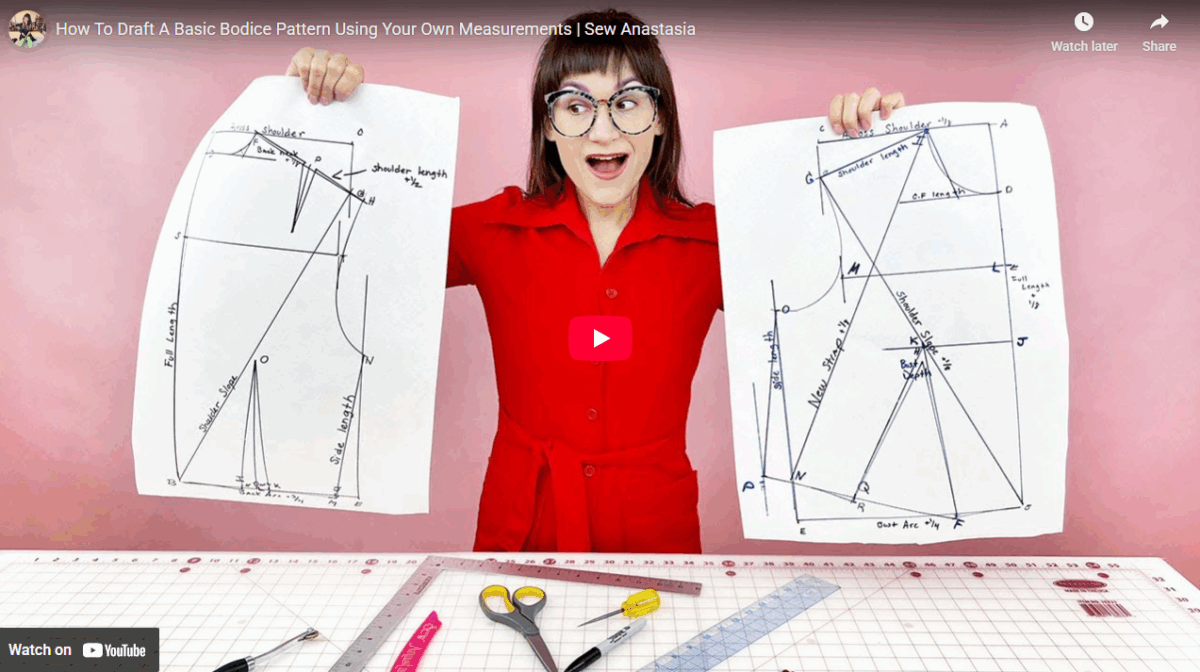
How to Draft a Basic Bodice Block
Step-by-Step Instructions:
Learn how to draft a basic bodice block from your own measurements to create a custom-fitted foundation pattern for blouses, dresses, and jackets—perfect for sewists ready to design garments that fit their unique body shape with precision and ease.
Materials Needed:
- Pattern drafting paper or large roll of kraft paper
- Clear plastic ruler (18–24 in with grid)
- L-square or right-angle ruler
- French curve or hip curve ruler
- Pencil (mechanical pencil recommended for precision)
- Eraser
- Fabric measuring tape
- Calculator
- Paper scissors or rotary cutter and mat for cutting out final block
- Optional: Tracing wheel and tracing paper for transferring darts
- Optional: Red pencil for marking front block, blue for back block
Tips for Perfect Bodice Block Drafting:
- Take accurate measurements: Wear a well-fitted bra and measure over a close-fitting top; have someone help you measure for best accuracy.
- Record all measurements: Write them down with the date; body measurements change and you’ll want to reference them later.
- Use ease appropriately: A basic block includes zero or minimal ease (0–1 in); you’ll add wearing ease when creating patterns from the block.
- Draft the back block first: The back bodice has less shaping and is easier to draft; it also informs the front block construction.
- Check your math: Bodice drafting involves calculations; double-check all arithmetic before drawing lines.
- Label everything: Mark grainlines, center front, center back, dart legs, notches, and seamlines clearly on your finished block.
- Test in muslin: Always sew a test garment (toile) from your drafted block in muslin or scrap fabric to check fit before using it to create patterns.
- Keep it as a master: Trace your finished block onto sturdy tagboard or Swedish tracing paper; never cut the master—always trace from it.
1. Take Your Body Measurements
- Bust: Measure around the fullest part of the bust, keeping the tape parallel to the floor.
- Waist: Measure around the natural waistline (narrowest part of the torso); tie a string or elastic around the waist to find it.
- High bust: Measure around the body directly under the arms and above the bust.
- Shoulder length: Measure from the base of the neck (side of neck) to the shoulder point (where the arm joins the shoulder).
- Back width: Measure across the back from armpit to armpit (approximately 4–5 in down from the neck).
- Across chest: Measure across the front from armpit to armpit at the same level as back width.
- Front bodice length: Measure from the base of the neck at the shoulder seam, over the bust apex, down to the waist.
- Back bodice length: Measure from the prominent bone at the base of the neck (C7 vertebra) straight down the spine to the waist.
- Shoulder slope: Optional but helpful; measure from the side of the neck down to the shoulder point and note the angle.
- Armhole depth: Measure from the top of the shoulder straight down to 1 in below the armpit (or use the calculation: 1/4 bust + 2 in).
2. Draft the Back Bodice Block
- Draw a vertical line on the left side of your paper equal to your back bodice length; label the top point A and the bottom point B (this is the center back line).
- From point A, draw a horizontal line to the right equal to 1/2 bust measurement plus 1 in ease, divided by 2 (example: if bust is 36 in, draw 9.5 in); label the end point C (this is the shoulder line at the neckline).
- From point B, draw a horizontal line to the right the same distance as AC; label the end point D (this is the waistline).
- From point A, measure down the center back line the calculated armhole depth (1/4 bust + 2 in); mark this point E and draw a horizontal line to the right equal to the AC measurement; label the end point F (this is the chest/underarm line).
- Measure 1/3 the distance from A to C along the top horizontal line and mark a small arc; this locates the back neckline curve starting point.
- From point A, measure up 1 in and mark point G; using a French curve, draw a smooth curve from G to the 1/3 mark on the shoulder line (this is the back neckline).
- Measure down from point C along the side edge a distance equal to your shoulder length measurement; mark this point H (this is the shoulder point).
- Draw a line from the 1/3 neckline mark to point H to complete the shoulder seam; adjust the slope if needed based on your shoulder slope measurement.
- From point H, draw the armhole curve down to point F on the underarm line using a French curve; the curve should be smooth and perpendicular to the underarm line at point F.
- From point F on the underarm line, measure 1–2 in toward the center back and mark point I; this creates side seam ease.
- Draw a straight line from point I down to point D at the waistline to create the side seam.
- Calculate the back bodice dart: measure the difference between the bust and waist measurements, divide by 4 (one dart for each bodice quarter); the back dart typically takes about 1 in of this total.
- Locate the back dart placement approximately 3–4 in from the center back on the waistline; draw two dart legs from this point up toward the shoulder blade area (approximately 5–6 in long); each dart leg should measure half the dart width away from the center dart line.
3. Draft the Front Bodice Block
- Begin a new draft or work on the right side of your paper; draw a vertical center front line equal to your front bodice length; label the top point J and bottom point K.
- From point J, draw a horizontal line to the right equal to the same measurement used for the back bodice (1/2 bust measurement plus 1 in ease, divided by 2); label the end point L.
- From point K, draw a horizontal line to the right the same distance; label the end point M.
- From point J, measure down the calculated armhole depth and mark point N; draw a horizontal line to the right equal to JL; label the end point O (this is the front underarm line).
- Measure 1/3 the distance from J to L along the top horizontal line; from this point measure down the calculated front neckline drop (typically bust/6 + 1 in); mark this point P.
- Using a French curve, draw the front neckline from point J curving smoothly down to point P.
- From point P, draw the shoulder seam up toward the armhole; the shoulder length should match the back shoulder length; mark the shoulder point Q.
- Locate the bust apex point: measure down from point P along the center front line a distance equal to your high bust to full bust distance (typically 6–10 in depending on cup size); measure horizontally from center front toward the side a distance equal to approximately half the across chest measurement; mark the apex point R.
- Draft the front bust dart: from the bust apex point R, draw one dart leg to a point on the shoulder seam approximately 1–2 in from the neckline; draw the other dart leg down toward the side seam at the underarm line. The total dart width should accommodate the difference between high bust and full bust measurements (typically 2–4 in total dart intake).
- Alternative: Draw the bust dart from the apex to the waistline instead of the shoulder for a different dart placement (you can rotate the dart later).
- From point Q (shoulder point), draw the front armhole curve down to point O on the underarm line using a French curve; the front armhole is typically deeper and more curved than the back.
- From point O, measure 1–2 in toward center front and mark point S; this creates the side seam ease to match the back.
- Draw the side seam from point S down to point M at the waistline.
- Add a front waist dart if needed (smaller than the back dart, typically 0.5–0.75 in); position it below the bust apex approximately 1 in toward the side seam.
4. True the Bodice Block Seams
- Check that the shoulder seam lengths match on front and back; adjust if necessary.
- Walk the side seams: pivot the front and back pieces so the side seams align; they should be equal in length from underarm to waist. If they don’t match, adjust the curves slightly.
- Check the armhole curves: the front and back armhole should meet smoothly at the shoulder and underarm points; adjust curves if there are sharp angles.
- Ensure the waistline is straight and horizontal on both front and back when laid flat.
- Verify all dart legs are equal in length; if not, true them so they end at the same distance from the dart point.
5. Add Seam Allowances and Markings
- Add seam allowances if desired (typically 5/8 in for garment sewing; blocks are often drafted without seam allowances).
- Mark grainlines: vertical line parallel to center front and center back.
- Mark notches: single notch on front armhole, double notch on back armhole; match notches at side seams.
- Label each pattern piece clearly: “Front Bodice Block” and “Back Bodice Block” with your name and date.
- Mark the bust apex point on the front block with a small circle or cross.
- Indicate “Place on Fold” on center front and center back if drafting a half-block.
6. Cut Out and Store Your Block
- Carefully cut out the front and back bodice blocks along the outer seamlines.
- Trace the blocks onto sturdy tagboard, poster board, or Swedish tracing paper for a durable master copy.
- Store your blocks flat in a large envelope or pattern storage box; label the outside with your measurements and date.
- Never cut your master blocks—always trace from them when creating new patterns.
7. Test Your Bodice Block
- Trace the front and back blocks onto muslin or scrap fabric; add seam allowances if not already included.
- Sew the bust darts, back dart, and any waist darts first.
- Sew the shoulder seams, then the side seams.
- Try on the muslin bodice (wrong side out for ease of marking); pin or baste it closed if there’s no closure.
- Check the fit: the block should fit snugly with minimal ease; look for pulling, wrinkling, or gaping.
- Mark any needed adjustments directly on the muslin with a fabric marker.
- Transfer adjustments back to your paper block and redraft if necessary.
8. Troubleshooting Common Issues
- Neckline too tight or too loose: Adjust the neckline curve by adding or removing 1/4–1/2 in; retest.
- Shoulder seam sliding forward or back: Adjust shoulder slope by raising or lowering the armhole end of the shoulder seam.
- Armhole too tight: Increase armhole depth by 1/4–1/2 in and redraw the armhole curve.
- Bust dart not pointing to apex: Remeasure your bust apex location and adjust dart placement; the dart should end 1 in before the apex point.
- Gaping at center front: Reduce the front neckline width or increase the bust dart intake.
- Back pulling across shoulder blades: Increase back width measurement or add a small horizontal dart at the shoulder blade area
More Sewing Techniques!

Top FAQs for this technique:
A bodice block (or sloper) is a basic fitted foundation with minimal or no ease, no style lines, and no seam allowances. You use it to create patterns with design details, ease, and seam allowances.
A basic block typically has 0–1 in of ease total. You’ll add wearing ease (2–4 in) when creating garment patterns from the block depending on the desired fit.
No, you draft one basic block from your measurements. You adjust ease and design details when creating patterns for specific fabrics (e.g., knits vs wovens require different ease).
Redraft your block whenever your body measurements change significantly (usually 1 in or more in bust, waist, or body length). Review measurements every 6–12 months.