
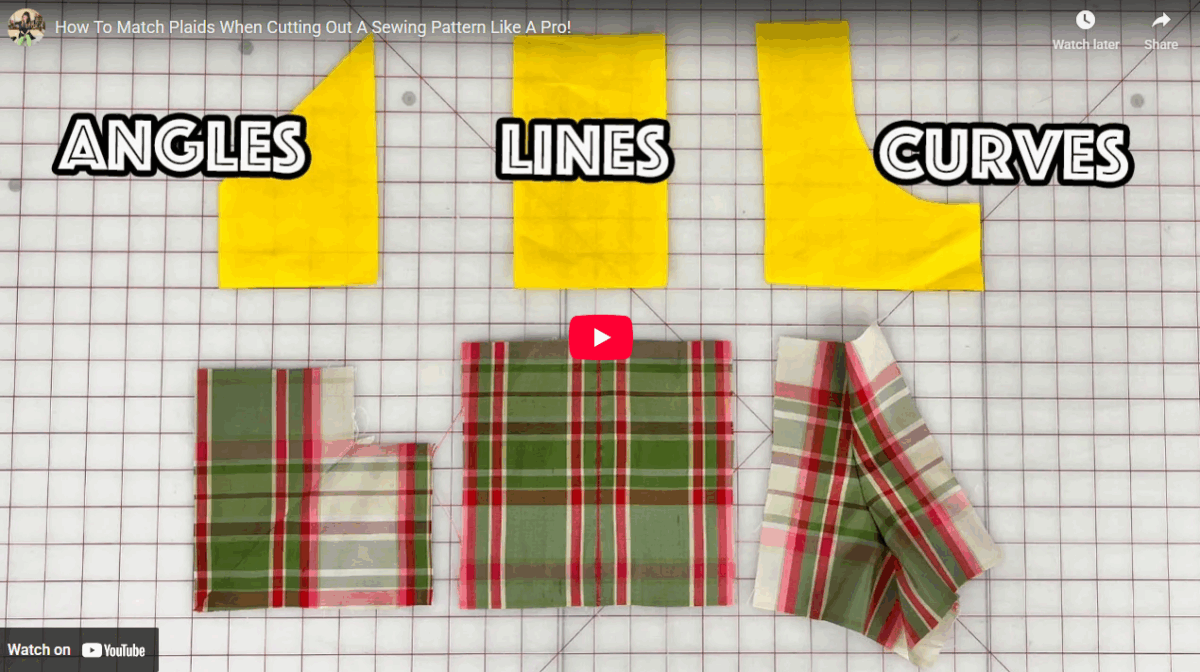
How to Match Patterns
Sewing Stripes and Plaids
Step-by-Step Instructions:
Learn how to match patterns when sewing stripes and plaids to achieve seamless, professional seams where design lines align perfectly—essential for polished garments, home décor projects, and quilts that showcase precision craftsmanship.
Materials Needed:
- Striped or plaid fabric (woven cotton, linen, wool, or rayon)
- Sewing pattern with seam allowances marked
- Extra fabric yardage (plaids and stripes require 1/4 to 1/2 yard extra per garment)
- Fabric scissors or rotary cutter and mat
- Quilting ruler or clear gridded ruler
- Fabric marking tool (tailor’s chalk, washable marker, or fabric pen)
- Silk pins or extra-fine pins
- Basting thread or hand-sewing needle for temporary basting
- Sewing machine and matching thread
- Iron and pressing surface
- Optional: Wonder Clips for thick or slippery fabrics
- Optional: Pattern matching notcher or single-hole punch
Tips for Perfect Pattern Matching:
- Buy extra fabric: Matching patterns requires strategic placement and may increase yardage by 1/4 to 1 yard depending on repeat size and pattern pieces.
- Identify the repeat: Measure the distance between identical stripes or plaid intersections (the repeat) to plan cuts and seam placement.
- Use a single layer: Lay fabric right side up in a single layer when cutting so you can see and control pattern placement on every piece.
- Match at key seams first: Prioritize matching at center front, side seams, and shoulder seams; secondary seams like armholes can be less critical.
- Mark the dominant line: Choose one strong stripe or plaid line as your reference and match it consistently across all pattern pieces.
- Work with the fabric grain: Stripes and plaids must be cut on-grain or pattern matching will be impossible; check that stripes run parallel to selvage.
- Pin perpendicular to seam: Insert pins at right angles through matched points so you can sew over them or remove them just before the needle reaches them.
- Baste first for complex matches: Hand-baste or machine-baste matched seams before final stitching to prevent shifting.
- Press as you go: Press seams open or to one side immediately after stitching to check alignment and make corrections if needed.
- Accept imperfection on curves: Curved seams (necklines, armholes) cannot match perfectly due to fabric stretch and shaping; focus on straight seams.
1. Pre-Wash and Press the Fabric
- Pre-wash and dry your striped or plaid fabric according to fiber content to eliminate shrinkage.
- Press the fabric thoroughly so stripes and plaids lie flat and true; wrinkles distort pattern lines and make matching impossible.
- Fold fabric in half lengthwise, right sides together, aligning selvages; check that stripes or plaid lines match at the fold. If they do not, your fabric is off-grain and must be straightened by pulling on the bias until lines align.
2. Analyze the Pattern Repeat
- Identify the repeat of your stripe or plaid: measure the distance from one dominant line to the next identical line in both vertical and horizontal directions.
- Note whether the plaid is even (symmetrical on both sides of a center line) or uneven (asymmetrical); even plaids are easier to match.
- Determine which lines you want to match at seams: typically the most prominent stripe or the intersection of two dominant plaid lines.
- Record repeat measurements and mark your chosen reference line on the fabric edge with chalk.
3. Plan Pattern Piece Placement
- Decide which seams must match: center front, center back, side seams, and shoulder seams are top priorities; sleeve and pocket placement are secondary.
- Lay out pattern pieces on a single layer of fabric, right side up, so you can see stripe and plaid placement on each piece.
- Position the first piece (usually center front) so your chosen reference line falls at a flattering location (e.g., dominant stripe at bust line or hem).
- Before cutting, place adjacent pattern pieces (center back, side front, side back) next to the first piece and align seam lines; check that the reference stripe or plaid intersection will meet when seams are sewn.
4. Mark Seam Matching Points
- At each seam that will be matched, measure from the cut edge to the reference line on the first pattern piece; note this measurement.
- Transfer this measurement to the adjacent piece: measure the same distance from the cut edge and mark the seam line where the reference line should align.
- Use a fabric pen or chalk to mark small dots or notches at these matching points on both pieces.
- Repeat for all seams requiring pattern matching (side seams, shoulder seams, center seams, etc.).
- Optional: Use a single-hole punch or pattern notcher to create small notches at matching points for precise alignment.
5. Cut Pattern Pieces Carefully
- Cut each piece individually from a single layer so you maintain control over pattern placement.
- Double-check that stripes or plaids are aligned with pattern grainline arrows before cutting.
- For symmetrical pieces (like front bodice cut on the fold), ensure the fold line falls exactly on a plaid or stripe line so both sides mirror each other.
- Label each piece on the wrong side with its name and matching points to avoid confusion during assembly
6. Pin and Align Seams for Matching
- Place two pieces to be joined right sides together.
- Insert a pin perpendicular to the seam line at the first marked matching point, piercing through both layers exactly at the reference stripe or plaid line.
- Insert a second pin at the next matching point, ensuring the stripe or plaid continues uninterrupted across the seam.
- Add additional pins between matching points every 1 to 2 inches, keeping fabric taut but not stretched.
- Check alignment from the right side by gently folding the seam allowance back; the pattern should appear continuous across the seamline.
7. Baste the Seam (Optional but Recommended)
- For critical seams or thick fabrics, hand-baste along the seam line using a contrasting thread and long running stitches.
- Basting holds the match in place and allows you to check alignment before permanent stitching.
- Alternatively, machine-baste using the longest stitch length on your machine.
- Remove pins as you baste or leave them in place if basting by hand.
8. Stitch the Seam
- Set your machine to a standard straight stitch (2.5 mm stitch length).
- Stitch slowly along the seam line, removing pins just before the needle reaches them or stitching over perpendicular pins if your machine allows.
- Keep fabric layers aligned by gently guiding (not pulling) the fabric through the machine.
- Backstitch at the beginning and end of the seam to secure stitches.
9. Press and Check the Match
- Press the seam flat as sewn to set the stitches.
- Open the seam and press seam allowances open (or to one side, depending on your pattern instructions) using a hot iron and steam.
- Flip the fabric right side up and check the match: stripes or plaids should align seamlessly at the seam.
- If the match is off, use a seam ripper to remove stitches, re-pin, and re-stitch. Small adjustments at this stage save frustration later.
10. Repeat for All Matched Seams
- Continue matching and stitching remaining seams in order: side seams, shoulder seams, sleeve seams if applicable.
- For intersecting seams (e.g., where side seams meet a waistband or yoke), match the dominant line first, then adjust secondary lines as closely as possible.
- Press each seam immediately after stitching to maintain crisp, aligned results.
11. Handle Difficult Areas
- Curved seams: Do not attempt to match curves (necklines, armholes); instead, match the straight portions leading into the curve and allow the curve to ease naturally.
- Bias-cut pieces: Bias edges stretch and distort pattern lines; avoid matching seams on bias unless using stable interfacing or stay-stitching.
- Gathers or pleats: Match the pattern at the seam line before gathering; once gathered, the pattern will no longer align, but the seam itself will be matched.
- Collars and cuffs: Match collar and cuff pieces to garment body at attachment points for a cohesive look.
12. Final Pressing and Finishing
- Press all matched seams one final time from the right side, using a press cloth to protect the fabric.
- Trim and finish seam allowances with a serger, zigzag stitch, or pinking shears to prevent fraying.
- Try on the garment or inspect the project to confirm all key seams are matched and the overall pattern flow is balanced and pleasing.
More Sewing Techniques!

Top FAQs for this technique:
Plan for an additional 1/4 to 1 yard depending on the size of the repeat and the number of pattern pieces. Larger repeats and more seams require more fabric.
Matching is very difficult on knits due to fabric stretch and distortion. Focus on woven fabrics with stable stripes or plaids for best results.
No. Prioritize matching at center front, center back, side seams, and shoulder seams. Curved seams like armholes and necklines cannot match perfectly and should not be forced.
Uneven plaids require cutting all pieces in the same direction (no flipping or rotating). Mark the top of each pattern piece and lay all pieces with tops pointing the same way on a single fabric layer.
Fabric may have been cut off-grain or stretched during sewing. Always straighten fabric before cutting and avoid pulling fabric through the machine.